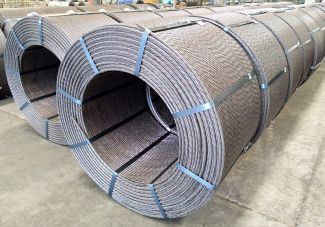
The series table, as listed on the MIC product page
The table below quotes the 1x7 series figures from the MIC product page: the 1x7 structure, the nominal diameters, the two tensile strength grades, and the relaxation figure for a thousand-hour test. Those figures describe the series as listed, and they do not describe any single coil, batch, or order. A buyer who needs figures for a specific quantity should name the diameter and the grade in the inquiry and ask for the matching document for that quantity.
The standards GB/T5224-2014 and ASTM A416/A416M:2012 appear on the MIC product page in connection with this series, and they are named here only as standards named on that source page. A standard name on a product page is not the same as a document held for a particular order, and this page does not present it as one. The standards guide explains how to turn a standard name into a project requirement by naming it in the inquiry and asking for the document itself.
Reading the table without over-reading it
A series table answers the question of what sizes and grades the series covers, and it does not answer the question of what a particular shipment will measure. Diameter, tensile grade, and relaxation each need a document for the specific order before they can be treated as agreed, and the inquiry is the place to ask for that document. A buyer who skips that step and treats the series table as an order specification risks a mismatch between the table and the delivered coils.
The same caution applies to the other strand structures named on the official site. The 1x2 and 1x3 PC strand structures and the compacted steel strand appear as homepage column names, and this site gives them no tables, listing them as homepage column names only. A buyer interested in one of those structures should name it in the inquiry and ask whether a series table or a document is available for it.
Applications named by the sources
The sources name application areas for the steel line, including bridges, railways, highways, subways, tunnels, airports, power stations, real estate construction, geotechnical works, industrial buildings, and precision manufacturing on the MIC side, and energy, mining, and building on the official homepage side. Those areas are listed on the applications overview page without performance wording.
An application area helps a buyer describe the project, but it does not by itself settle the product choice. A bridge project, a tunnel project, and a mining project may all use strand, yet each may need a different diameter, grade, or document. The strand selection guide walks through those distinguishing questions, and the inquiry checklist gathers them into a form that can be sent with the first message.
What to put in a strand inquiry
A strand inquiry should name the series, the nominal diameter from the table, the tensile grade, and the application area, together with the quantity range and the destination. If a standard applies to the project, name it exactly, including the year and part where the project cites one, because a paraphrased standard can point to the wrong document. If a certificate document is needed for the destination market, name that document as well, and ask for it before the order is placed.
Please confirm the minimum order quantity, the lead time, and the payment terms in your inquiry before you place an order. Those commercial points are not stated on this site, because the source pages publish no fixed commercial terms for the strand series. Asking them in the first message, together with the technical points, lets the company reply with terms that match the specific diameter, grade, and quantity in question.
Related steel names, kept at name level
Prestressed concrete wire and anchorage are listed on their own pages at name level, without tables, because the source pages list them without detail. Cable bolt strand and rock bolt bar appear on the steel index as names from the mining and geotechnical area, also without tables. Keeping those names at name level is not a gap in the site; it is the accurate reflection of what the sources support, and a buyer who needs detail for one of those names should ask for it by name in the inquiry.
The metal-ceramic material in the steel line follows the same discipline in a stricter form. It appears only in the parallel form, metal-ceramic material (spelled cermet on the official site and cermel on the MIC showroom), and it has no detail page, so both spellings stay side by side wherever the material is mentioned. A buyer who recognises that material under either spelling can mention both spellings in the inquiry, so the company can confirm which material is meant.
| Item | As listed |
|---|---|
| Structure | 1x7 |
| Nominal diameters | 9.5, 11.10, 12.70, 15.20, 15.70, 17.80 mm |
| Tensile strength grades | 1860, 1960 N/mm² |
| Relaxation, 1000 h test | Not more than 2.5% |
| Standards named on the source page | GB/T5224-2014; ASTM A416/A416M:2012 (source mentions only, not a compliance statement) |
Source note: the figures above are quoted from the MIC product page for the 1x7 series. They describe the series as listed and do not describe any single coil, batch, or order.